Author: Thejaswini MA
Original title: Coinbase 's Walled Garden
Compiled and edited by: BitpushNews
A recurring pattern emerges across different industries, eras, and markets. First comes explosive growth: a proliferation of players claiming to perform a specific task better than others. Expertise surges, and utility tools multiply. Consumers are told "choice equals freedom" and "customization equals power," and the future belongs to disruptors who dismantle monolithic giants.
Then, silently, the pendulum inevitably swung back.
This isn't because the experts are wrong, nor because the giants are so great. It's because fragmentation carries an invisible, compounding cost. Each additional tool means another password to remember, another interface to learn, and another potential point of failure in the system you're maintaining. Autonomy begins to feel like "working for someone else," and freedom begins to feel like an "administrative burden."
In the integration phase, the ultimate winners aren't those who do everything perfectly. They are those who do so many things well enough that the friction costs of leaving (and rebuilding the entire system elsewhere) become insurmountable. They don't hold you back with contracts or lock-in periods. They hold you back with convenience. Through countless subtle integrations and small accumulations of efficiency, these small gains, though not worth sacrificing for any one of them, collectively form a moat.
We've seen this before in e-commerce. It's happened in cloud computing, in streaming media. Now, we're witnessing it in the financial sector.
Coinbase has just placed a bet on the phase of the cycle we are entering.
Back to the background
For most of its existence, Coinbase's positioning was clear. It was where Americans could buy Bitcoin without worrying about appearing to be engaging in some kind of ambiguous criminal activity. It had regulatory licenses, a clean interface, and customer support that, while often criticized, was at least theoretically present. In 2021, the company went public with a valuation of $65 billion, its rationale being that it was the "gateway to cryptocurrency." For a time, this logic held true.
But by 2025, "being an entry point to cryptocurrency" was starting to look like a bad business. Spot trading fees were being squeezed. Retail trading volume exhibited dramatic cyclicality: soaring in bull markets and crashing in bear markets. Bitcoin believers (Maxis) were increasingly accustomed to using self-custodied wallets. Regulators were still suing the company. Meanwhile, Robinhood , which started with stock trading and then entered the crypto space, suddenly reached a market capitalization of $105 billion, almost twice that of Coinbase.
In 2021, over 90% of Coinbase's revenue came from transaction commissions. By the second quarter of 2025, this proportion had dropped to below 55%.
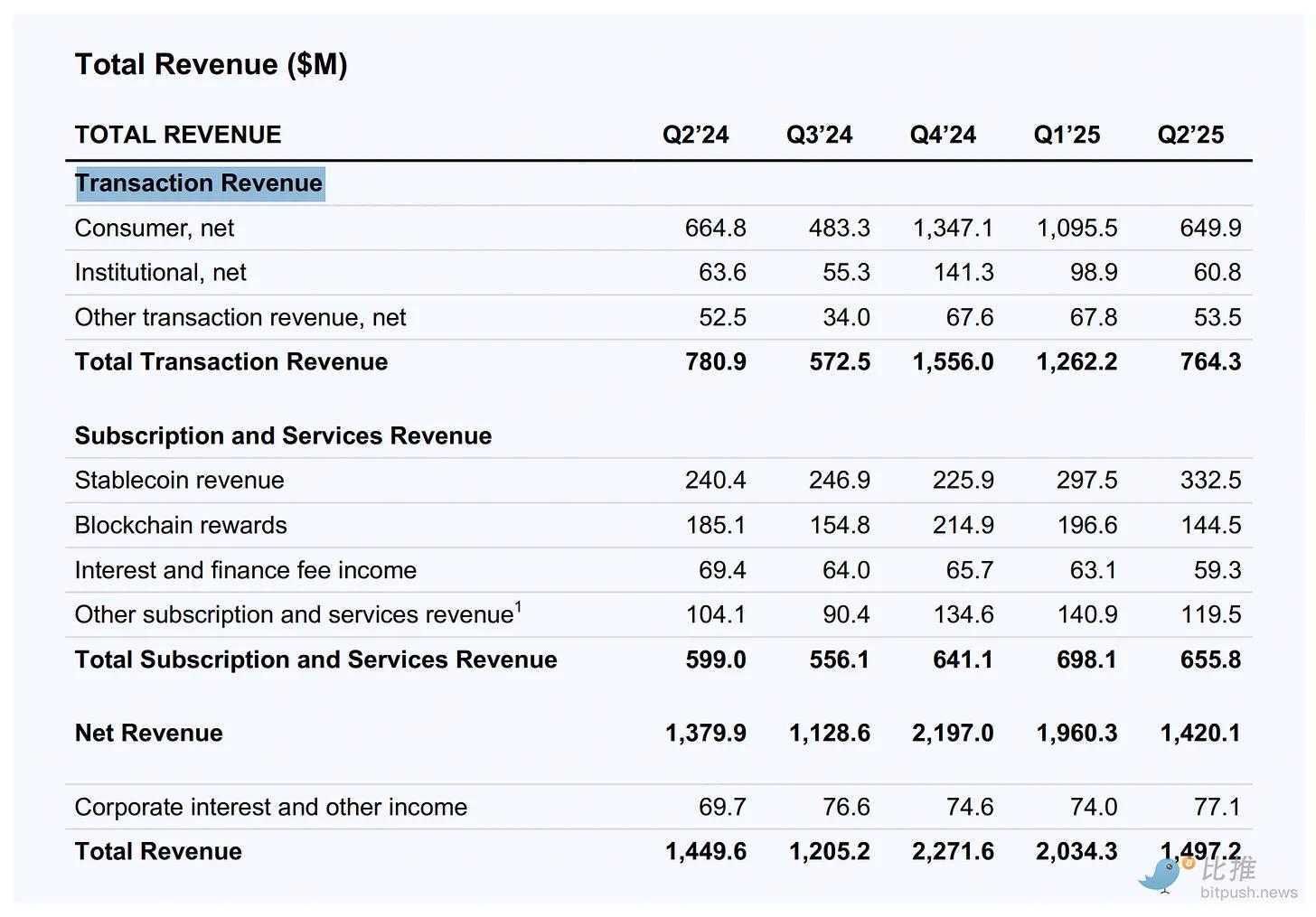
Therefore, Coinbase did what it should do when its core product is under pressure: it tried to become "everything else".
"Omnipotent Exchange " Hypothesis
The so-called "Everything Exchange" hypothesis is a bet that aggregation will prevail over specialization.
Stock trading means users can now react to Apple's earnings reports using USDC at midnight without leaving the app.
Prediction markets mean they can check prices for "Will the Fed cut interest rates?" during lunch.
The perpetual contracts mean they can leverage their Tesla positions up to 50 times on Sunday.
Each new feature module is yet another reason to open the app, and yet another opportunity to capture stablecoin interest generated from price spreads, transaction fees, or idle balances.
Is the strategy "Let us become Robinhood", or "Make sure our users never need Robinhood"?
There's an old adage in the fintech world: users want specialized apps. One for investing, one for banking, one for payments, and one for cryptocurrency. Coinbase bets the opposite: once you complete KYC (Know Your Customer) once and link your bank account once, you don't want to do the same thing nine more times elsewhere.
This is the argument that "aggregation trumps specialization." In a world where underlying assets are increasingly becoming tokens on the blockchain, this makes perfect sense. If stocks are tokens, prediction market contracts are tokens, and Meme Coin is a token, why shouldn't they all be traded in the same place?
The mechanical logic is: you deposit USD (or USDC), you trade everything, and you withdraw USD (or USDC). There are no cross-chain transfers between platforms, and no minimum balance requirements for multiple accounts. There is only one pool of funds flowing between asset classes.
Flywheel effect
The more Coinbase resembles a traditional brokerage, the more it needs to compete on the same terms as traditional brokerages. Robinhood has 27 million funding accounts, while Coinbase has approximately 9 million monthly active trading users. The competitive differentiator cannot simply be "we also have stocks," but must lie in the underlying architecture (Rails).
Their commitment is to provide 24/7 liquidity for everything. There are no market closures, no settlement delays. When the market moves against you, there's no need to wait for your broker to approve your margin request.
Does this matter to most users? Probably not right now. Most people don't need to trade Apple stock at 3 a.m. on a Saturday. But some people do. If you're the place that lets them do that, you get their flow. Once you have flow, you have data. With data, you can build a better product. With a better product, you get even more flow.
This is a flywheel, provided that the flywheel can rotate.
Game of prediction markets
Prediction markets are the most unusual, and perhaps most important, part of this "gift package." They are not "trades" in the traditional sense, but rather organized games of chance regarding binary outcomes: Will Trump win? Will the Fed raise interest rates? Can the Lakers make the playoffs?
Contracts disappear after settlement, so there is no long-term holder community. Liquidity is event-driven, meaning it is explosive and unpredictable. However, platforms like Kalshi and Polymarket saw monthly trading volumes surge to over $7 billion in November.
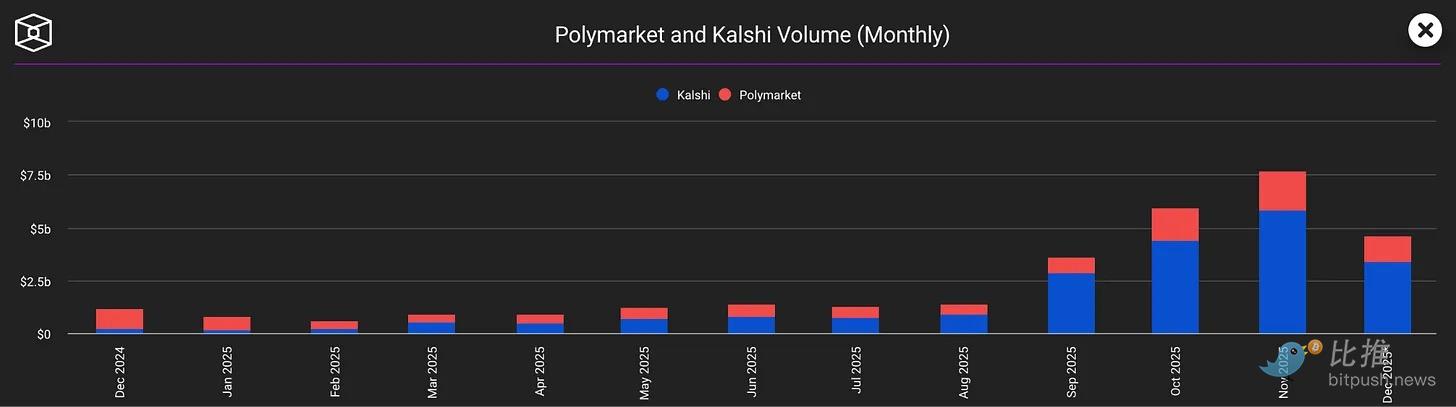
Why? Because prediction markets are social tools. They're a way to express opinions with stakes. They're a reason you check your phone in the fourth quarter of a game or on election night.
For Coinbase, prediction markets solve a specific problem: engagement. Cryptocurrencies get boring when prices are flat. Stocks get boring when your portfolio is just sitting there. But there are always events happening in the world that people care about. Integrating Kalshi gives users a reason to stay on the app even when Bitcoin isn't moving.
The bet posits that users drawn to the election market will stay and trade stocks, and vice versa. More functional surface area equates to higher user engagement.
The essence of a business model: profit margin
Strip away the narrative of innovation, and what you really see is a company trying to monetize the same user in more ways:
Stock trading fees
Price difference for DEX (decentralized exchange) exchanges
Interest on stablecoin balances
Loan fees for crypto asset-backed loans
Coinbase One subscription revenue
Infrastructure costs incurred by developers using the Base blockchain
This is not criticism. This is how exchanges operate. The best exchanges are not those with the lowest fees, but those that users cannot leave—because leaving means rebuilding the entire system elsewhere.
Coinbase is building a walled garden, but the walls are built on "convenience," not on forced entry. You can still withdraw your cryptocurrency, and you can still transfer stocks to Fidelity. But you probably won't, because why bother?
Base: The Real Killer Weapon
Coinbase's strength should lie in its "on-chain" capabilities. It could offer tokenized stocks, instant settlement, and programmable funds. But currently, its stock trading looks similar to Robinhood, just with extended trading hours; its prediction market looks similar to Kalshi, just with a different app embedded.
The real differentiation must come from the base—the Layer 2 blockchain that Coinbase builds and controls. If stocks truly flow on-chain, if payments truly use stablecoins, and if AI agents truly begin trading autonomously using the x402 protocol, then Coinbase will have built something that Robinhood cannot easily replicate.
But this is a long-term story. In the short term, the key to competition lies in whose app has the most stickiness. Adding more features does not equate to increasing stickiness. It can also make the app cluttered, confusing, and stressful for new users who just want to buy some Bitcoin.
Scale vs. Purity
A segment of crypto users will hate all of this: the true believers. Those who want Coinbase to be the gateway to decentralized finance (DeFi), not a centralized "super app" that just happens to have some DeFi features tucked into its submenus.
Coinbase has clearly chosen scale over purity. It wants 1 billion users, not 1 million purists. It wants to be the default financial venue for the general public, not the exchange favored by those running their own nodes.
This might be the right business decision. The mass market doesn't care about decentralization. The mass market prioritizes convenience, speed, and avoiding financial loss. If Coinbase can provide these, the underlying philosophy doesn't matter.
But this does create a peculiar tension. Coinbase is trying to be both the infrastructure of the on-chain world and a centralized exchange competing with Schwab; it's trying to be a defender of cryptocurrency and a company dedicated to making it "invisible." It wants to be rebellious while also complying with regulatory requirements.
Perhaps this is achievable. Perhaps the future trend is a regulated on-chain exchange that feels like using Venmo. Or perhaps, trying to provide everything for everyone means you end up being no special to anyone.
This is Amazon's strategy. Amazon isn't the best in any single area: it's not the best bookstore, not the best grocery store, and not the best streaming service. But it's "good enough" in all of them that most people don't bother going anywhere else.
However, many companies have tried to build an "all-in-one app," but most of them have only built a messy app.
If Coinbase can capture the entire closed loop of "earning, trading, hedging, lending, paying, and recycling," then whether a single feature is slightly inferior to its professional competitors becomes irrelevant. Switching costs and the hassle of managing multiple accounts will keep users within the ecosystem.
That's all about Coinbase, the "all-in-one exchange".
Twitter: https://twitter.com/BitpushNewsCN
BitPush Telegram Community Group: https://t.me/BitPushCommunity
Subscribe to Bitpush Telegram: https://t.me/bitpush